
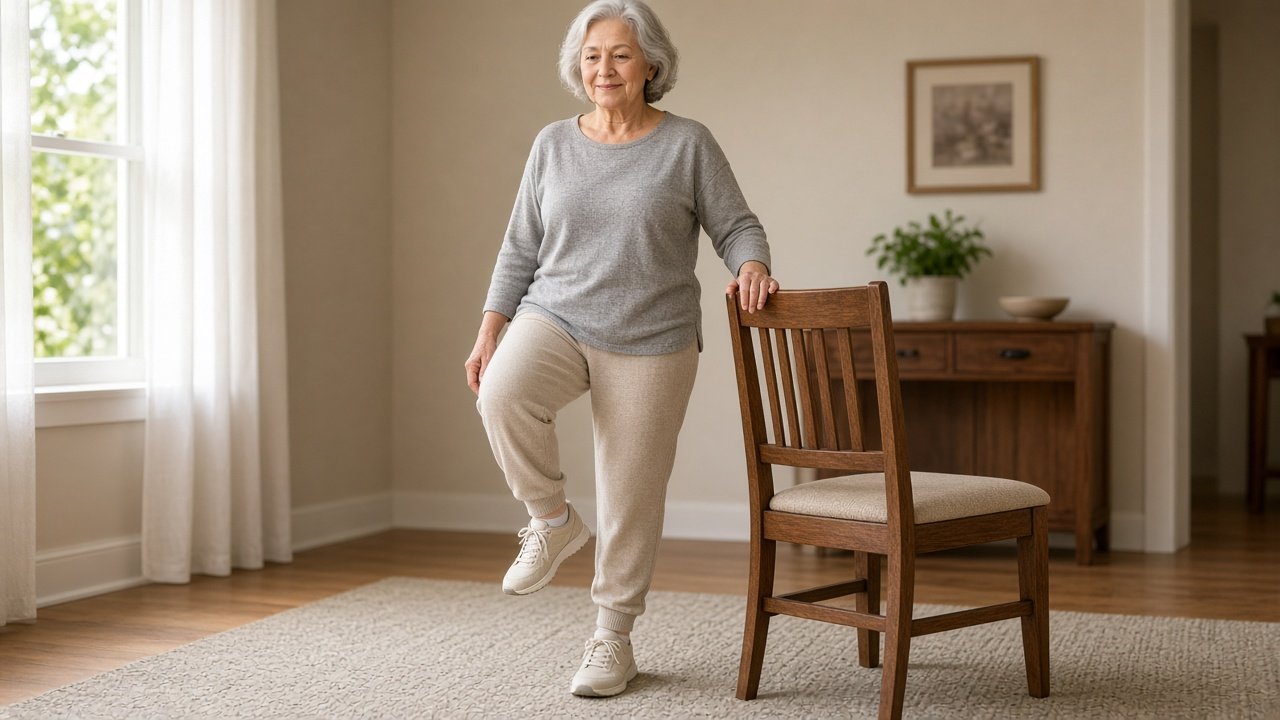
After 60, many people notice something subtle but unsettling: a little more caution on stairs, a tighter grip on the railing, or a moment of wobble when turning quickly. That feeling is common—and it is not a personal failure. Balance naturally changes with age as muscle strength, reaction time, and joint awareness shift.
The hopeful part is that balance is trainable. You do not need a gym membership or complicated equipment. A few minutes of focused practice near a sturdy chair or counter can rebuild steadiness, strengthen the legs and ankles, and restore confidence in everyday movement.
The six balance exercises below are designed for seniors who want practical, at-home fall-prevention training. They mirror the kinds of movements leading health organizations recommend—sit-to-stand, heel-to-toe walking, supported single-leg holds, heel raises, side steps, and gentle marching—written in plain language for real life.
Important: If you have had a recent fall, feel dizzy, have significant joint pain, or use a walker or cane most of the day, check with your clinician or a physical therapist before starting. These moves are for people who can stand safely with light support nearby.
Why Balance Declines After 60 (And Why Training Helps)
Balance is not one single skill. It is a team effort between:
- Leg and hip strength that keeps you upright when you shift weight
- Ankle and foot control that corrects small wobbles before they become trips
- Reaction speed so you can catch yourself if you stumble
- Sensory awareness (proprioception) that tells your brain where your body is in space
As people sit more and challenge their balance less, those systems get quieter. The result can look like “aging,” when much of it is simply under-use. Gentle, repeated balance practice wakes those systems back up—without pounding the joints.
Fall risk rises with age for many adults, and falls remain a leading cause of injury later in life. That statistic is not meant to scare you. It is a reminder that a small daily habit can protect independence: walking to the mailbox, getting out of a chair, turning in the kitchen, or stepping over a doorway threshold.
Safety First: Set Up Before You Start
Before any balance practice:
- Clear a path—rugs, cords, and low furniture should be out of the way.
- Wear supportive, non-slip shoes (or bare feet on a non-slip surface if that feels safer for you).
- Stand near a sturdy chair, counter, or wall you can touch lightly.
- Move slowly. Speed is not the goal; control is.
- Stop if you feel sharp pain, spinning dizziness, chest discomfort, or sudden weakness—and contact a clinician if those symptoms appear.
Start with a firm handhold. As you feel steadier over days and weeks, progress to a fingertip touch, then hovering the hand just above the support. Never rush that progression.
Exercise 1: Sit-to-Stand (Chair Rise)
Why it matters after 60
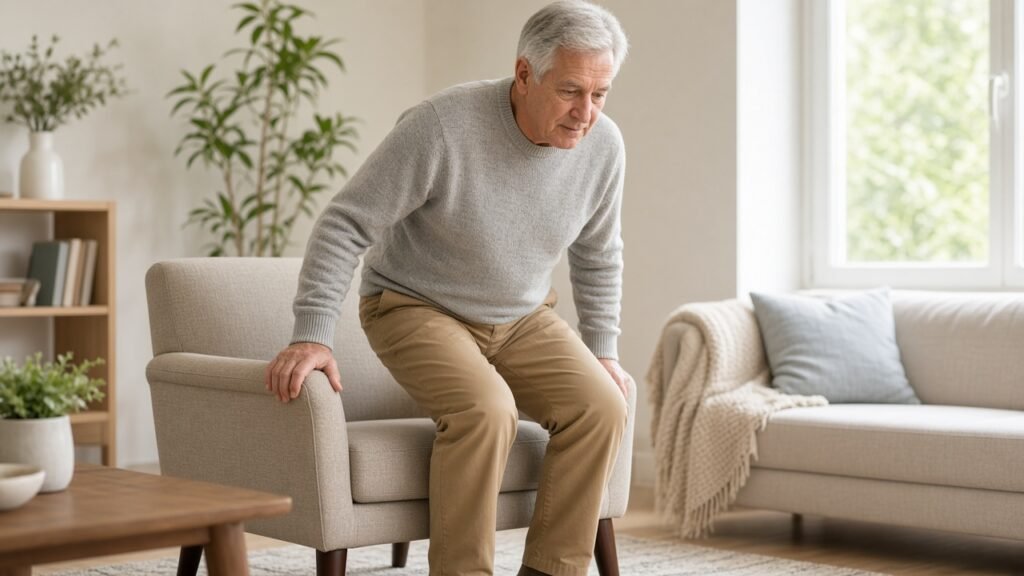
Getting up from a chair is one of the most important functional movements of daily life. Stronger thighs and hips make standing safer and reduce the need to “throw” yourself upward with momentum.
How to do it
- Sit near the front edge of a sturdy chair, feet flat, about hip-width apart.
- Lean slightly forward from the hips (nose over toes).
- Push through your heels and stand up with control.
- Pause tall for a second, then sit back down slowly.
- Repeat 5–8 times.
Use the armrests only as much as you need. Over time, try a lighter touch so your legs do more of the work.
Benefits
- Builds leg strength for stairs and transfers
- Improves body mechanics for safer standing
- Translates directly to real-life independence
Exercise 2: Heel-to-Toe Walk (Walk the Line)
Why it matters after 60
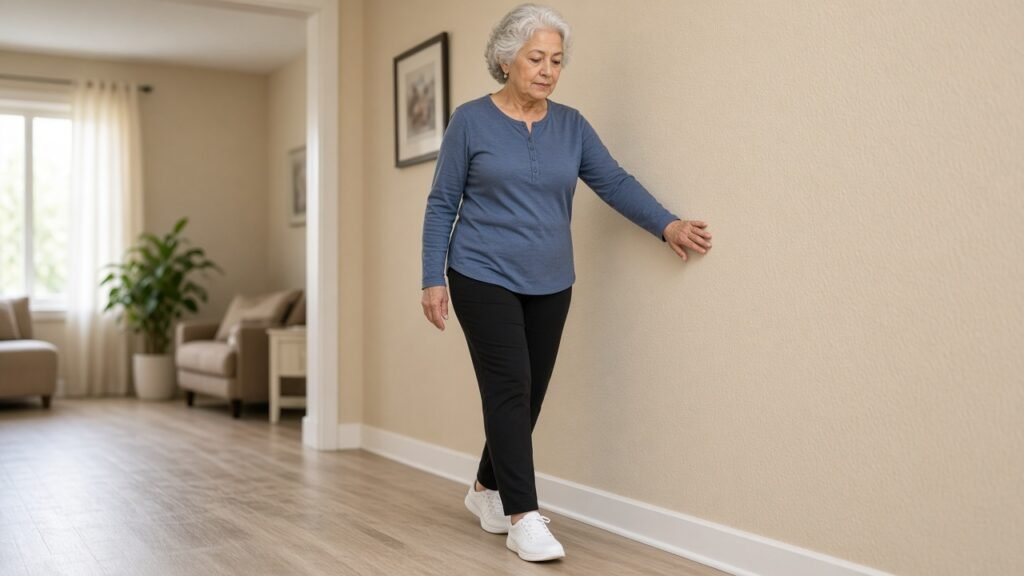
Narrowing your base of support challenges balance the way uneven sidewalks and tight spaces do. Heel-to-toe walking trains focus, foot placement, and mid-line stability.
How to do it
- Stand tall beside a wall or hallway for light support.
- Place one foot directly in front of the other so the heel of the front foot touches the toes of the back foot.
- Take 5–10 slow steps forward in a straight line.
- Turn carefully (use the wall), then repeat if space allows.
Keep your eyes forward when you can; glancing down briefly to place your feet is fine at first.
Benefits
- Improves walking confidence
- Sharpens coordination and attention
- Strengthens ankle and hip stabilizers
Exercise 3: Supported Single-Leg Stand
Why it matters after 60
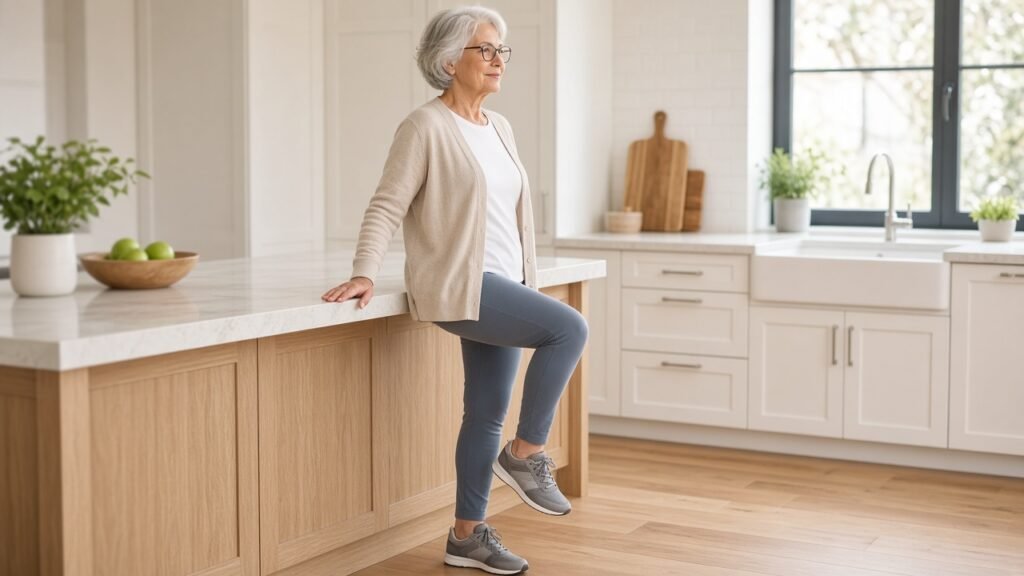
Everyday life is full of single-leg moments: putting on pants, stepping into a bathtub, or recovering from a slight trip. Training one-leg balance in a controlled setting prepares you for those moments.
How to do it
- Stand beside a sturdy chair or kitchen counter.
- Lightly hold the support with one hand.
- Shift weight onto one leg and lift the other foot a few inches (knee bent or foot hovering behind).
- Hold 5–10 seconds (work toward 20–30 seconds as it gets easier).
- Switch sides. Do 3 holds per leg.
If lifting the foot feels too hard, start by shifting most of your weight to one leg while keeping the other toes lightly touching the floor (“toe-touch assist”).
Benefits
- Builds ankle and hip stability
- Improves reaction and posture control
- Boosts confidence for everyday single-leg tasks
Exercise 4: Heel Raises (Rise Up on Toes)
Why it matters after 60
Your calves and smaller foot muscles are the first line of defense when you sway. Stronger ankles mean quicker, quieter corrections before a stumble turns into a fall.
How to do it
- Stand tall, holding a chair or counter lightly.
- Slowly rise onto the balls of your feet as if peeking over a fence.
- Hold 2–3 seconds, then lower with control.
- Repeat 8–12 times.
Keep knees soft—not locked. Avoid bouncing.
Benefits
- Strengthens calves, feet, and ankles
- Supports steadier standing and walking
- Easy to practice while waiting for the kettle
Exercise 5: Side Steps (Lateral Weight Shift)
Why it matters after 60
Many falls happen sideways—reaching for something, turning, or stepping around an obstacle. Side steps train the outer hips and teach your body to move laterally with control.
How to do it
- Stand facing a counter or with a chair nearby.
- Step one foot out to the side, then bring the other foot to meet it (keep a small gap between feet).
- Take 8–10 steps in one direction, then return the other way.
- Keep your torso tall and look forward.
Progress by reducing hand support, not by speeding up.
Benefits
- Strengthens hip stabilizers
- Improves side-to-side control
- Helps with kitchen, bathroom, and crowded-room movement
Exercise 6: March in Place (Gentle Knee Lifts)
Why it matters after 60
Marching warms the body, wakes up the hips, and practices the foot clearance you need to avoid catching a toe on rugs or thresholds.
How to do it
- Stand tall beside support.
- Lift one knee gently (even a few inches counts), then switch.
- March slowly for 30–60 seconds.
- Rest, then repeat once more if you feel good.
Land softly. Think “quiet feet.”
Benefits
- Improves circulation and coordination
- Prepares legs for walking
- Makes a simple warm-up before the other moves
A Practical 15-Minute Balance Routine
Try this sequence most days (or at least 3 days a week):
| Step | Move | Time / reps |
|---|---|---|
| 1 | March in place | 1 minute |
| 2 | Sit-to-stand | 5–8 reps |
| 3 | Heel raises | 8–12 reps |
| 4 | Heel-to-toe walk | 5–10 steps each way |
| 5 | Side steps | 8–10 each way |
| 6 | Single-leg stand | 3 holds per side |
| 7 | Easy walk around the room | 2–3 minutes |
Consistency beats intensity. A calm 15 minutes practiced regularly usually outperforms a hard session you dread and skip.
Extra Habits That Support Better Balance
Alongside these drills, many seniors benefit from:
- Daily walking at a comfortable pace
- Tai chi or gentle yoga classes designed for older adults
- Strength work for the legs and hips (even bodyweight moves count)
- Home safety checks: better lighting, grab bars where needed, and clear floors
Balance training works best as part of an active life—not as a one-time fix.
When to See a Clinician
Reach out to your doctor or a physical therapist if you:
- Have fallen in the past year, or nearly fall often
- Feel dizzy, lightheaded, or unsteady most days
- Notice sudden changes in walking, vision, or sensation in your feet
- Have osteoporosis, neuropathy, recent surgery, or heart/lung limits that make standing exercise uncertain
A professional can screen your fall risk and tailor progressions so you stay challenged without being unsafe.
Final Thoughts: Steadiness Is a Skill You Can Rebuild
Feeling less steady after 60 is common. Becoming more steady again is possible. These six balance exercises—sit-to-stand, heel-to-toe walking, supported single-leg stands, heel raises, side steps, and marching—give you a clear, home-friendly path to stronger legs, sharper balance reflexes, and more confidence in daily life.
Start near support. Move slowly. Practice a little more often than you think you “need” to. Over weeks, many people notice they turn with less caution, stand from chairs more easily, and walk with a quieter mind.
Aging does not have to mean giving up independence. It can mean training the skills independence depends on—one careful step at a time.